Condition
What the finding is, how it is assessed, which treatments address it in Glasgow, what will not work, how long results take and what moves the cost.
Far more often about shape. The complaints that bring people in are usually a lost vermilion border, an upper lip that has flattened and lengthened, asymmetry, or a downturn at the corners. Each of those is a proportion problem, and each is made worse rather than better by adding volume indiscriminately. Assessment establishes which of them applies before any product is discussed.
Treatments that address this
The lip does not simply deflate. Several things happen together and they produce a characteristic appearance that people describe as thinner lips when the change is more structural than that.
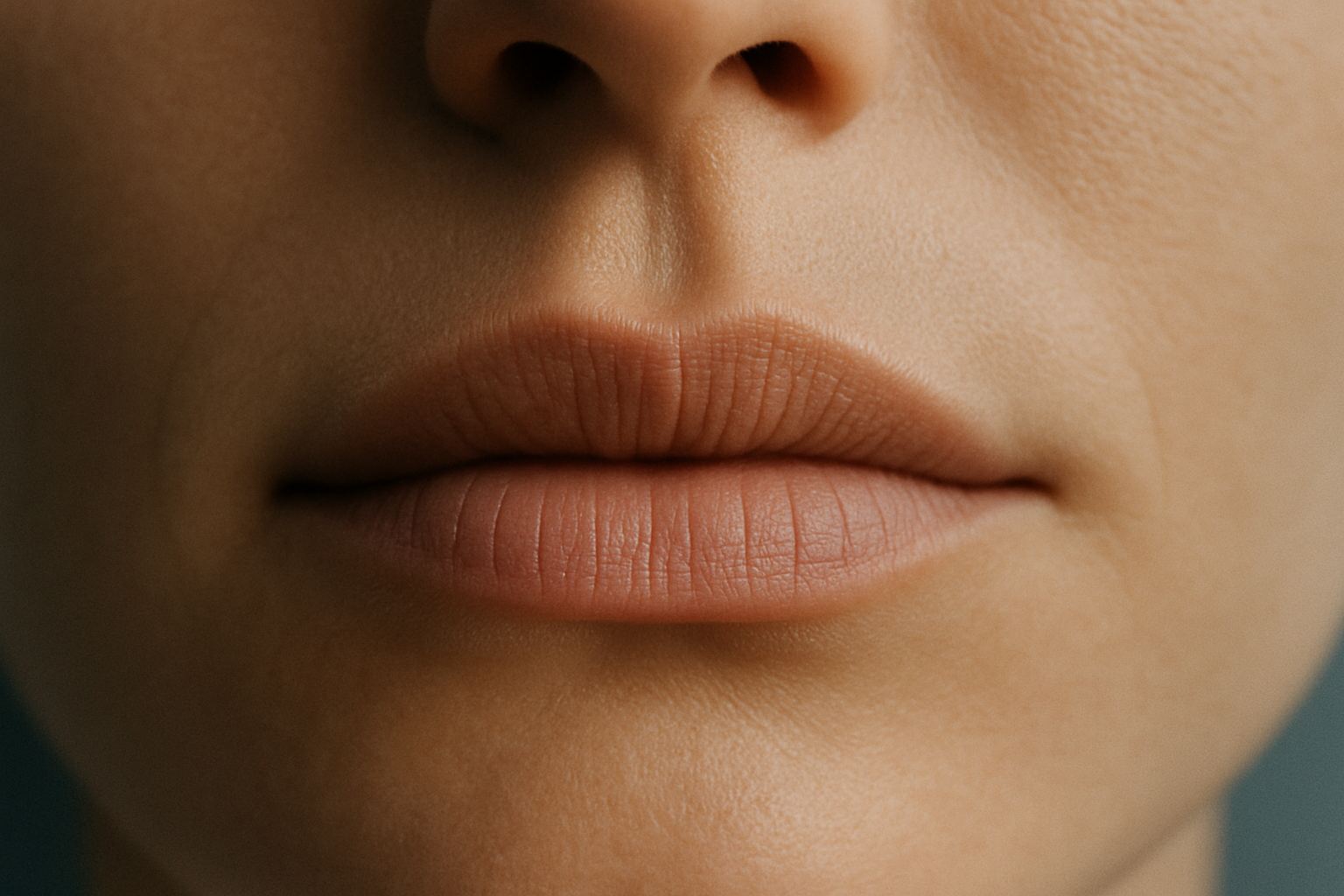
The upper lip lengthens as the skin between the base of the nose and the vermilion border relaxes, so less red lip shows and the teeth are less visible at rest and on speaking. The vermilion border, the crisp ridge separating red lip from skin, softens and loses definition, which is why lipstick begins to migrate into fine lines. The cupid's bow flattens. Volume is lost from the body of the lip, and the bone of the upper and lower jaw resorbs beneath it, removing support.
Repeated muscle action around the mouth etches fine vertical lines into skin that has lost collagen, and sun exposure and smoking accelerate that considerably. The corners of the mouth turn down as the muscles pulling them down go unopposed.
People ask for fuller lips. What they usually mean is a lip that is the shape it used to be.
This is the area where assessment most obviously separates a result people like from a result people recognise from across a room.
Adding volume to a lip whose problem is a lost border produces a rounded, undefined lip that looks larger and less like the original. It is the commonest cause of a result the patient cannot explain their dissatisfaction with.
Injecting into fine vertical lines above the lip, close to the surface, produces visible ridging and a characteristic flattening of the philtrum. The lines are a skin problem.
Repeated large-volume treatment stretches the tissue and predisposes to migration, where product moves above the border and creates the shelf that is instantly recognisable. Migration is more likely with excessive volume, superficial placement, treatment repeated before the previous product has substantially resorbed, and firm gels used where soft ones belong.
Ask whether hyaluronidase is held on the premises, in date, and who is competent to use it. In the lip this is not only an emergency question; it is also how an unsatisfactory or migrated result is corrected. A clinic that cannot dissolve what it injects should not be injecting it.
Lips swell more than any other area of the face, sometimes dramatically, and the swelling peaks in the first 24 to 48 hours. The appearance in the first few days is not the result and should not be judged as one. Two weeks is the point at which the lip has settled.
Longevity is shorter here than elsewhere because the lip is mobile and well vascularised. Soft gels in the lip commonly last less time than firm gels placed on bone elsewhere in the face, and the range between individuals is wide. Metabolism and exercise load genuinely affect it.
The pattern of retreatment matters more than the interval. Waiting until the previous product has substantially resorbed, and treating conservatively each time, produces a lip that returns to its own baseline. Topping up on a schedule regardless of what remains is how tissue gets stretched.
Lip treatment is priced per treatment rather than per course, and the variables are narrower than for most conditions on this site, which makes the differences between quotations more revealing.
An offer materially below the market usually differs on the third or fourth of those points. What drives the price of treatment explains why.
Lips are the area where technique and restraint are most visible and where the consequences of poor placement are most public. They are also injected by a very wide range of people, because dermal fillers are regulated as medical devices rather than medicines and there is currently no general licensing requirement to inject them in the United Kingdom.
The standards to expect from a clinic in Glasgow sets all of this out in full.
Common questions
Less time than filler placed on bone elsewhere in the face, because the lip is mobile and well supplied with blood. The range between individuals is wide and metabolism and exercise load affect it. A range is more truthful than a figure, and the plan should say what happens when it fades rather than assuming a rebooking.
That is a planning decision rather than an inevitable consequence. Results that read as obvious usually involve too much volume for the face, product placed above the vermilion border, or repeated treatment before the previous product resorbed. Conservative first treatment and a two-week review are the safeguards.
Migration is product moving beyond the vermilion border into the skin above it, producing a visible shelf. Hyaluronic acid products can be dissolved with hyaluronidase, and correction is usually a matter of dissolving and allowing the tissue to settle before considering anything further. It is a reason to ask about hyaluronidase before you consent, not after.
More than anywhere else on the face, peaking in the first day or two. Bruising is possible. You should be told in writing what is expected and which symptoms mean you telephone rather than wait, particularly severe pain, blanching or a dusky colour change, which need to be seen urgently.
The fine vertical lines above the lip are a skin collagen problem and filler placed directly into them ridges and flattens the philtrum. They respond better to resurfacing or needling, sometimes with a small dose of botulinum toxin where muscle action is a significant driver.
Related reading
01
The most requested treatment in the country and the one where technique shows most obviously.
Read

02
A medical device rather than a medicine in the UK, which is precisely why the practitioner matters more than the product.
Read

03
Keep the area clean and undisturbed, avoid heat and strenuous exercise for around twenty four hours, stay upright for ...
Read
Enquiries
Tell us what you have noticed and how long it has been there. You will get a considered reply setting out which treatments apply to that finding, which do not, and what an assessment would need to establish first.
hello@aestheticlaunchlab.comPlease do not send clinical photographs or medical records by email. If something has gone wrong after a procedure, contact the practitioner who treated you, or NHS 111 in Scotland, rather than waiting for a reply.